- Zahnärzte Dres. Zimny & Kollegen
-
Uhlandstr. 53
10719 Berlin-Wilmersdorf - [email protected]
- 030 889 20 20 0

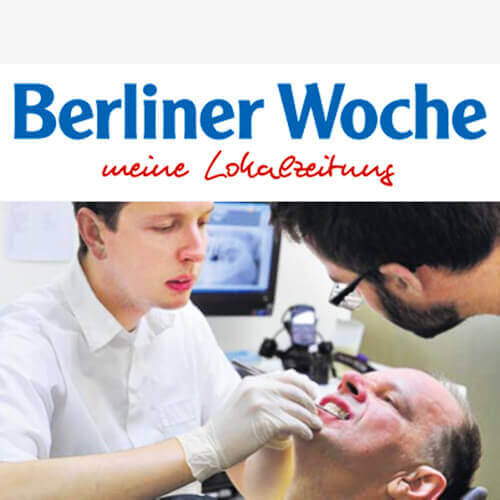

In zehn Stunden komplett bezahnt: Frank Liesegang erhielt seine Implantate am Morgen und ging noch am gleichen Abend mit neuer Lust am Lächeln wieder heim. (Foto:Schubert)
Kostenlose Beißer für neue Moral
Zahnarzt Burghardt Zimny spendiert „Charity-Behandlung“
Wilmersdorf. Binnen eines Tages verwandelte sich der zahnlose Patient in einen Mann mit frischem Lebensmut. Hätte er die Gebissrekonstruktion nach neuesten Methodik selbst bezahlen müssen, wäre er jetzt um 40 000 Euro ärmer.
„Ist ja irre!“ Frank Liesegang grinst in den Spiegel, zieht seine Lippen zurück, dreht den Kopf nach allen Seiten. Endlich Zähne. Der Patient umarmt seinen Arzt, empfindet ein Glück – so aufrichtig, so unverstellt, dass niemand behaupten kann, es träfe den Falschen. Bezahlt hat er keinen Cent, dafür aber etwas zurückgewonnen, womit er auf dem Arbeitsmarkt
bestehen kann: die Courage des gesunden Lachens. Draußen vor der Praxis ist ein Tag verdunkelt, an dessen Morgen man Liesegang noch zahnlos lispeln hörte. Vor zehn Jahren begab es sich, dass der Kraftfahrer nach einer eitrigen Kiefererkrankung seine Kauleisten verlor. Buchstäblich ohne Biss lebte er fortan, der Arbeitslosigkeit hingegeben und an starkem Übergewicht leidend, nur für die Erziehung seiner Tochter und fand weder Geld noch Zutrauen für zahnärztliche Hilfe.
Die Krankenkasse bezahlten dem 49-Jährigen zwar Prothesen. Aber nur solche, die ständig verschlissen oder die er nicht vertrug.
Einzigartiger Fall
Ein glücklicher Klick im Internet war es schließlich, der Frank Liesegang an die richtige Adresse brachte. Dr. Burghardt Zimny erkannte nämlich im Rahmen der Untersuchung, dass eine derart schwerwiegende Situation in der einschlägigen Literatur noch nirgends dokumentiert war. Und so gewann er, vermittelt von einem wissenschaftlichen Journal, einen Hersteller für Zahnersatz als Sponsor und hatte seinen Patienten binnen zwei Wochen operationsbereit. Acht Titanschrauben in den Oberkiefer, sechs Implantate in den unteren, darauf befestigt die Komplettverblendung mit Keramik, das alles im Eilverfahren mit der „Sofortbelastungsmethode“ – kostet normalerweise 40 000 Euro, in diesem Fall nur ein Lächeln. Und nun, da Liesegang seine Malzeiten endlich wieder mit belastbaren Zähnen zerkleinern kann, liegt auch der kulinarische Gelderwerb nicht mehr fern. Er wagt den Schritt in die Selbstständigkeit und verkauft daheim in Tempelhof Falafel, Kuskus und Pommes. tsc
( © Berliner Woche, KW 39/2011 )
Zahnärzte Dres. Zimny Berlin Erklärung zur Barrierefreiheit
We firmly believe that the internet should be available and accessible to anyone, and are committed to providing a website that is accessible to the widest possible audience, regardless of circumstance and ability.
To fulfill this, we aim to adhere as strictly as possible to the World Wide Web Consortium’s (W3C) Web Content Accessibility Guidelines 2.1 (WCAG 2.1) at the AA level. These guidelines explain how to make web content accessible to people with a wide array of disabilities. Complying with those guidelines helps us ensure that the website is accessible to all people: blind people, people with motor impairments, visual impairment, cognitive disabilities, and more.
This website utilizes various technologies that are meant to make it as accessible as possible at all times. We utilize an accessibility interface that allows persons with specific disabilities to adjust the website’s UI (user interface) and design it to their personal needs.
Additionally, the website utilizes an AI-based application that runs in the background and optimizes its accessibility level constantly. This application remediates the website’s HTML, adapts Its functionality and behavior for screen-readers used by the blind users, and for keyboard functions used by individuals with motor impairments.
If you’ve found a malfunction or have ideas for improvement, we’ll be happy to hear from you. You can reach out to the website’s operators by using the following email
Our website implements the ARIA attributes (Accessible Rich Internet Applications) technique, alongside various different behavioral changes, to ensure blind users visiting with screen-readers are able to read, comprehend, and enjoy the website’s functions. As soon as a user with a screen-reader enters your site, they immediately receive a prompt to enter the Screen-Reader Profile so they can browse and operate your site effectively. Here’s how our website covers some of the most important screen-reader requirements, alongside console screenshots of code examples:
Screen-reader optimization: we run a background process that learns the website’s components from top to bottom, to ensure ongoing compliance even when updating the website. In this process, we provide screen-readers with meaningful data using the ARIA set of attributes. For example, we provide accurate form labels; descriptions for actionable icons (social media icons, search icons, cart icons, etc.); validation guidance for form inputs; element roles such as buttons, menus, modal dialogues (popups), and others. Additionally, the background process scans all the website’s images and provides an accurate and meaningful image-object-recognition-based description as an ALT (alternate text) tag for images that are not described. It will also extract texts that are embedded within the image, using an OCR (optical character recognition) technology. To turn on screen-reader adjustments at any time, users need only to press the Alt+1 keyboard combination. Screen-reader users also get automatic announcements to turn the Screen-reader mode on as soon as they enter the website.
These adjustments are compatible with all popular screen readers, including JAWS and NVDA.
Keyboard navigation optimization: The background process also adjusts the website’s HTML, and adds various behaviors using JavaScript code to make the website operable by the keyboard. This includes the ability to navigate the website using the Tab and Shift+Tab keys, operate dropdowns with the arrow keys, close them with Esc, trigger buttons and links using the Enter key, navigate between radio and checkbox elements using the arrow keys, and fill them in with the Spacebar or Enter key.Additionally, keyboard users will find quick-navigation and content-skip menus, available at any time by clicking Alt+1, or as the first elements of the site while navigating with the keyboard. The background process also handles triggered popups by moving the keyboard focus towards them as soon as they appear, and not allow the focus drift outside it.
Users can also use shortcuts such as “M” (menus), “H” (headings), “F” (forms), “B” (buttons), and “G” (graphics) to jump to specific elements.
We aim to support the widest array of browsers and assistive technologies as possible, so our users can choose the best fitting tools for them, with as few limitations as possible. Therefore, we have worked very hard to be able to support all major systems that comprise over 95% of the user market share including Google Chrome, Mozilla Firefox, Apple Safari, Opera and Microsoft Edge, JAWS and NVDA (screen readers).
Despite our very best efforts to allow anybody to adjust the website to their needs. There may still be pages or sections that are not fully accessible, are in the process of becoming accessible, or are lacking an adequate technological solution to make them accessible. Still, we are continually improving our accessibility, adding, updating and improving its options and features, and developing and adopting new technologies. All this is meant to reach the optimal level of accessibility, following technological advancements. For any assistance, please reach out to